 Herring
 Felling means cutting a tree at the base and dropping it in one piece. Where there is room to do it, it is the fastest, cleanest and least expensive way to take a tree down, because the whole job happens from the ground rather than from a rope in the canopy.
The catch is the word room. A tree needs a landing area roughly as long as it is tall and wide enough to absorb the spread of the crown, plus a margin either side for the fact that no tree falls perfectly. That is a lot of clear ground, and most Derby gardens do not have it. This page explains how we work out whether yours does, and what happens if it does not.
Does Your Tree Have Anywhere to Fall?
The first thing we do on a felling visit is stand back and look for the drop zone. We are measuring the tree by eye against the space in front of it, and checking what sits inside that space and just outside it.
The things that most often rule felling out are:
- Overhead cables running across the garden or along the boundary
- A greenhouse, shed, oil tank or hot tub inside the fall line
- A neighbouring fence that would take the outer branches
- A conservatory or extension on either the tree’s side or next door’s
- A drive, path or parked car that cannot be cleared for the morning
- Soft or newly laid lawn, patio slabs or a pond that a falling stem would break
None of those automatically means the tree cannot come down. They mean it cannot come down in one piece, which is a different problem with a different answer.
How a Fell Is Actually Planned
Trees do not simply fall the way they lean. Weight distribution in the crown, wind on the day, and any decay in the base all pull the outcome around, which is why felling is a planned cut rather than a confident guess.
Before the saw goes in we will look at where the weight sits in the crown, whether the stem is sound at the base, which way the wind is running, and where everyone on site is going to stand. Escape routes get cleared behind the tree before any cutting starts, and where a tree needs persuading away from its natural lean, ropes and wedges do that job rather than optimism.
It is also why felling is not a good candidate for a do-it-yourself weekend. A stem that settles back onto the saw, or a tree that sits down on its own hinge, turns a straightforward job into a dangerous one in about a second and a half.
When Felling Is Not the Answer
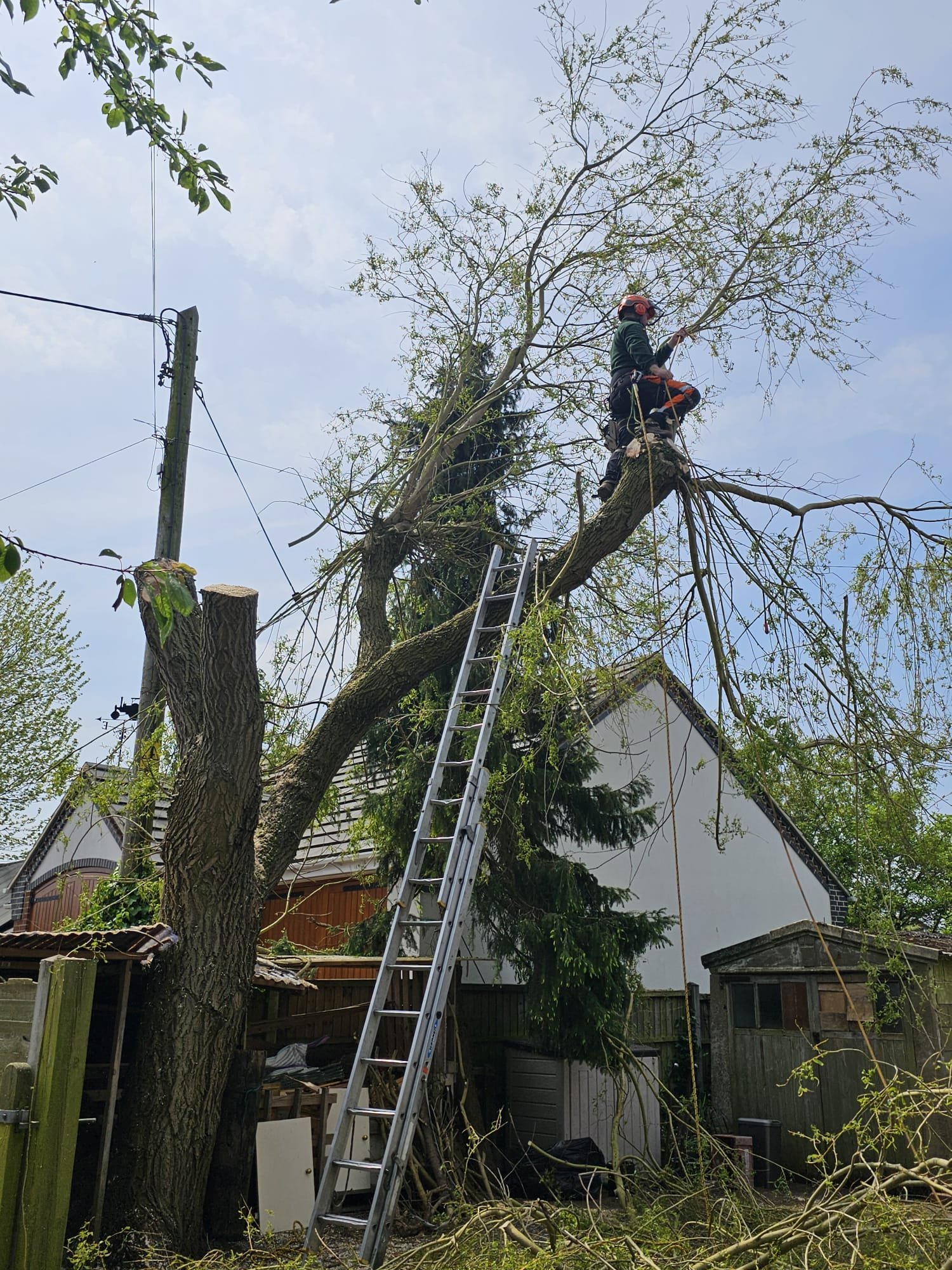
If the drop zone is not there, the tree comes down in sections instead — climbed or accessed from a platform, taken apart from the top, and lowered piece by piece. It takes longer and costs more than felling, and we will tell you that on the visit rather than after the invoice.
Our tree removal guide for Derby covers what drives the price of either approach, and the sectional dismantling section of our Derby page explains the alternative in more detail.
There is also a third answer that people do not always expect: sometimes the tree does not need to come down at all. If the actual complaint is shade in the kitchen, or branches over the shed, a crown reduction or a lift will often solve it and leave you with a tree. We would rather point that out than fell something that did not need felling.
Check Before You Fell — Protected Trees in Derby
Before we quote any felling job we check whether the tree carries a Tree Preservation Order or sits inside a Derby conservation area. Parts of Darley Abbey and the city centre have specific protections, and felling a protected tree without consent is an expensive mistake that lands on the property owner, not the contractor.
This check is standard on every job and costs you nothing. If the tree does turn out to be protected, that is not necessarily the end of it — it means an application or a notice has to go in first, and we will tell you what is involved.
What Happens to the Tree Afterwards
Once the tree is on the ground it gets processed where it lies. Brash goes through the chipper, the stem is cut into manageable lengths, and the site is raked over before we leave.
A few things worth deciding before the day rather than on it:
- Whether you want the logs left — say so and suitable timber can stay
- Whether you want the chip left for beds and paths, or taken away
- Whether the stump is going too, which is a separate grinding job
- Where the chipper and the truck can park, because that shapes the day
Stump grinding can be added to a felling job or booked separately later if you would rather deal with it another time.
Ready to book Tree Felling in Derby, or still have a question?
Get In Touch →