 Herring
 What to do in the hours after a tree has come down is covered in our article on dealing with storm-damaged trees, and if something is hanging or leaning right now, that is the page you want — or just call us.
This page is the other half of the subject, and the cheaper half. Trees very rarely fail at random. Most of the ones we clear up in January were showing something in autumn that nobody was looking for.
The Ground Tells You Most
Start at the bottom, because the base is where the failures that actually matter begin.
Walk right around the trunk and look at the soil where it meets the tree. You are looking for cracking, humping or a gap opening between the trunk and the ground, particularly on the opposite side to any lean. That means the root plate has started to move, and a tree that has begun to lift will not put itself back.
Also worth noting at the base: fungal brackets growing out of the trunk or the buttress roots, soft or hollow-sounding wood, and any area where bark has come away and not healed. None of those is automatically fatal. All of them are worth someone looking at before the wind picks up.
Then Look at the Unions
The place a large limb joins the stem is where big failures usually happen, and it is the part people never look at.
What matters is the shape of the join. A union that forms a rounded U with a raised collar of bark is generally strong. A tight V where two stems of similar size press against each other, with a seam of bark trapped between them, is weaker — the bark stops the two sides knitting together properly, so the join is holding on friction more than fibre.
A crack running down from a union, or a visible gap that opens and closes as the tree moves in wind, is the single clearest reason to get a professional look before winter.
The Crown, and What Is Under It
From the ground, in leaf, look for anything obviously out of place:
- Bare branches standing out against a full canopy
- A limb hanging at a different angle from its neighbours
- One side of the tree noticeably thinner or sparser than the other
- Broken ends left from a previous storm and never dealt with
- Ivy heavy enough that you cannot see the structure underneath it
- Growth pressing against a roof, a cable or a chimney
Then turn round and look at what is underneath. A tree with a fault over open lawn is a different priority from the same tree over a conservatory, a parked car or a pavement. Risk is the fault and the target together, never the fault alone.
Where Wind Actually Does the Damage
In a dense city, wind does not arrive evenly. It accelerates through gaps between buildings, funnels along the line of a street, and swirls in ways that put load on a tree from a direction it has never had to resist.
The trees that surprise people are often the ones that were sheltered until something changed — a neighbouring tree came down, a building went up or came down, or a row of conifers was reduced. A tree that has spent thirty years growing inside a windbreak has not built the structure to stand alone, and the first winter after it loses that shelter is the one that finds out.
If something around your tree has changed in the last couple of years, that is worth mentioning when you call.
What Not to Do With What You Find
Two honest warnings.
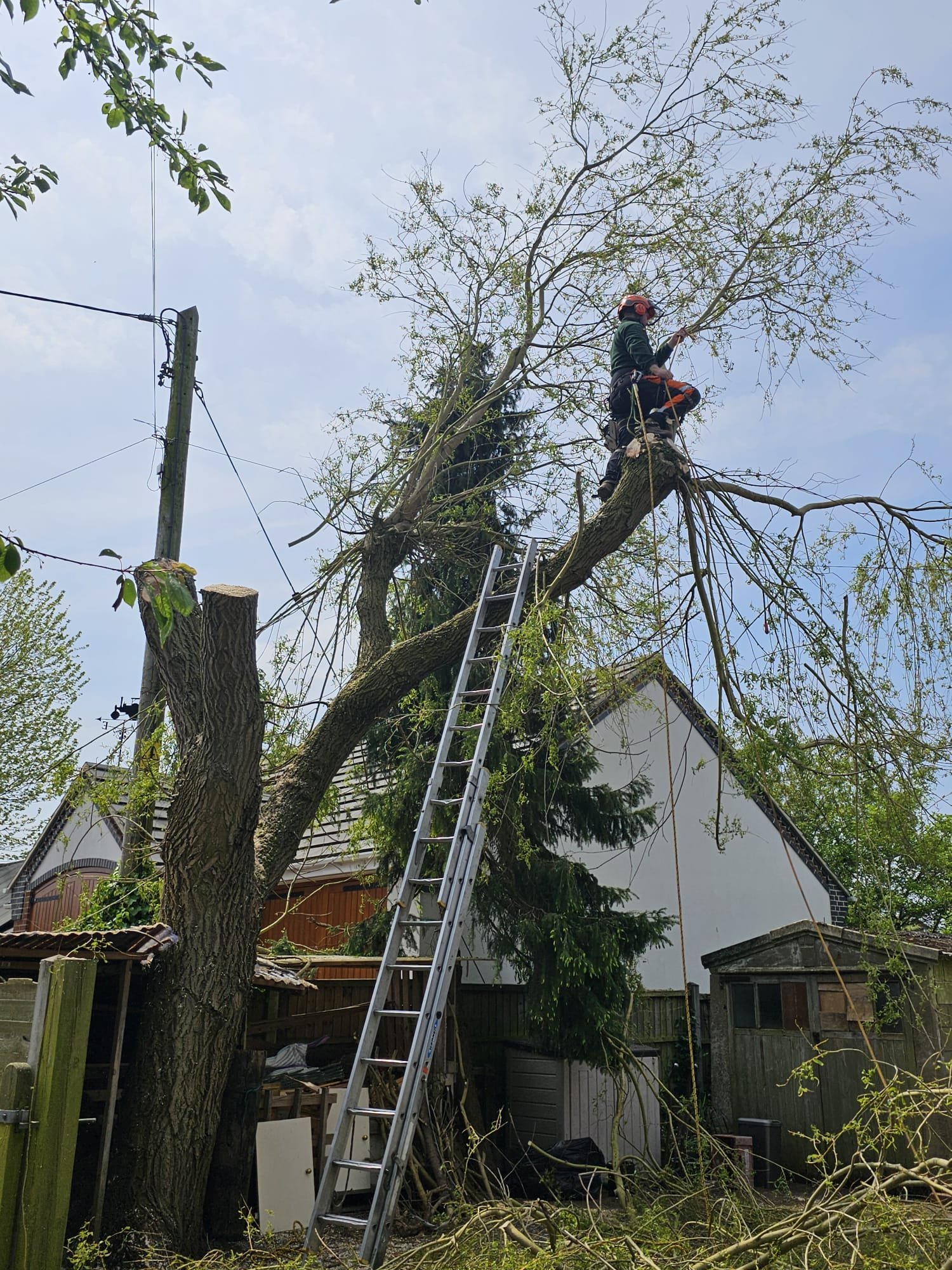
First, do not put a ladder against a tree you are worried about, and do not climb it to get a better look. If it needs looking at from height it needs looking at by someone on a rope.
Second, resist the urge to have the whole thing taken down because you found something. Most of what people find on this walk-round is either harmless or fixable — a reduction to take the sail out of a top-heavy crown, a brace, or simply keeping an eye on it. Removal is the last answer, not the first, and any tree surgeon who goes straight to it deserves a second opinion.
Ready to book Storm-Damaged Tree Work in Nottingham, or still have a question?
Get In Touch →