 Herring
 Almost every mature tree carries some dead wood. As a canopy spreads, the lower and inner branches lose their share of the light, stop earning their keep and are shed. A healthy oak or sycamore in a Nottingham garden will always have a few.
So the useful question is not whether there is deadwood. It is whether the pattern of it looks like normal shedding or like decline — and, separately, whether anything valuable is standing underneath it.
Normal Shedding Versus Decline
Normal shedding shows up low and inside the crown, on the branches that have been shaded out. It appears gradually and it does not get dramatically worse from one season to the next.
Decline looks different. It starts at the top and the outer edges of the crown and works inwards. It gets visibly worse year on year. It often sits alongside other signs — a thinner canopy, smaller leaves, fungal brackets at the base, or bark coming away in patches.
If we see the second pattern, we will say so, and the conversation becomes a proper look at the tree rather than a tidy-up. Cutting the dead bits out of a declining tree makes it look better without making it any safer, and that is not a job worth selling.
Ash Is the Big One Around Here
Ash dieback reached the UK in 2012 and has since spread through most of the country. Ash is one of the commonest trees in Nottinghamshire hedgerows and gardens, so it is the species we are asked about most.
What matters practically is not the diagnosis, it is the timeline. A declining ash sheds a lot of deadwood, and dead ash goes brittle noticeably faster than most species. That has two consequences worth knowing:
- Branches fail sooner, and with less warning, than on a comparable oak or sycamore
- There is a point at which the tree is no longer safe to climb, which removes the cheapest method and pushes the job towards machinery
- So a declining ash is one of the few cases where waiting genuinely costs more
That is not a reason to panic about every ash. Many carry on for years, and some show real resistance. It is a reason to have a declining one looked at this year rather than in three.
What Sits Underneath Still Decides It
Even on a perfectly healthy tree, deadwood over the patio is a different proposition from deadwood over the back hedge. Dead wood is brittle, it fails without warning, and it does not wait for a windy day.
The things that move a branch up the list are seating areas, paths and front doors, parked cars, greenhouses and roof lights, play equipment, and anything beyond the boundary — a pavement, a road, or a neighbour’s glass.
Height and thickness matter too. A pencil-thick twig at four metres is not a hazard. An arm-thick limb at twelve metres is.
Leave Some of It Where You Safely Can
There is a good argument against stripping every dead branch out of a tree. Standing deadwood is genuinely valuable habitat — for beetles, for fungi, and for the birds that feed on them — and it is scarcer in a tidy suburban garden than most people imagine.
Where deadwood sits over ground that nothing can be hurt on, we will often suggest leaving it. It costs you less and the tree keeps something useful. Directly above the seating area, it goes. Those two positions are not in tension.
How the Work Is Done
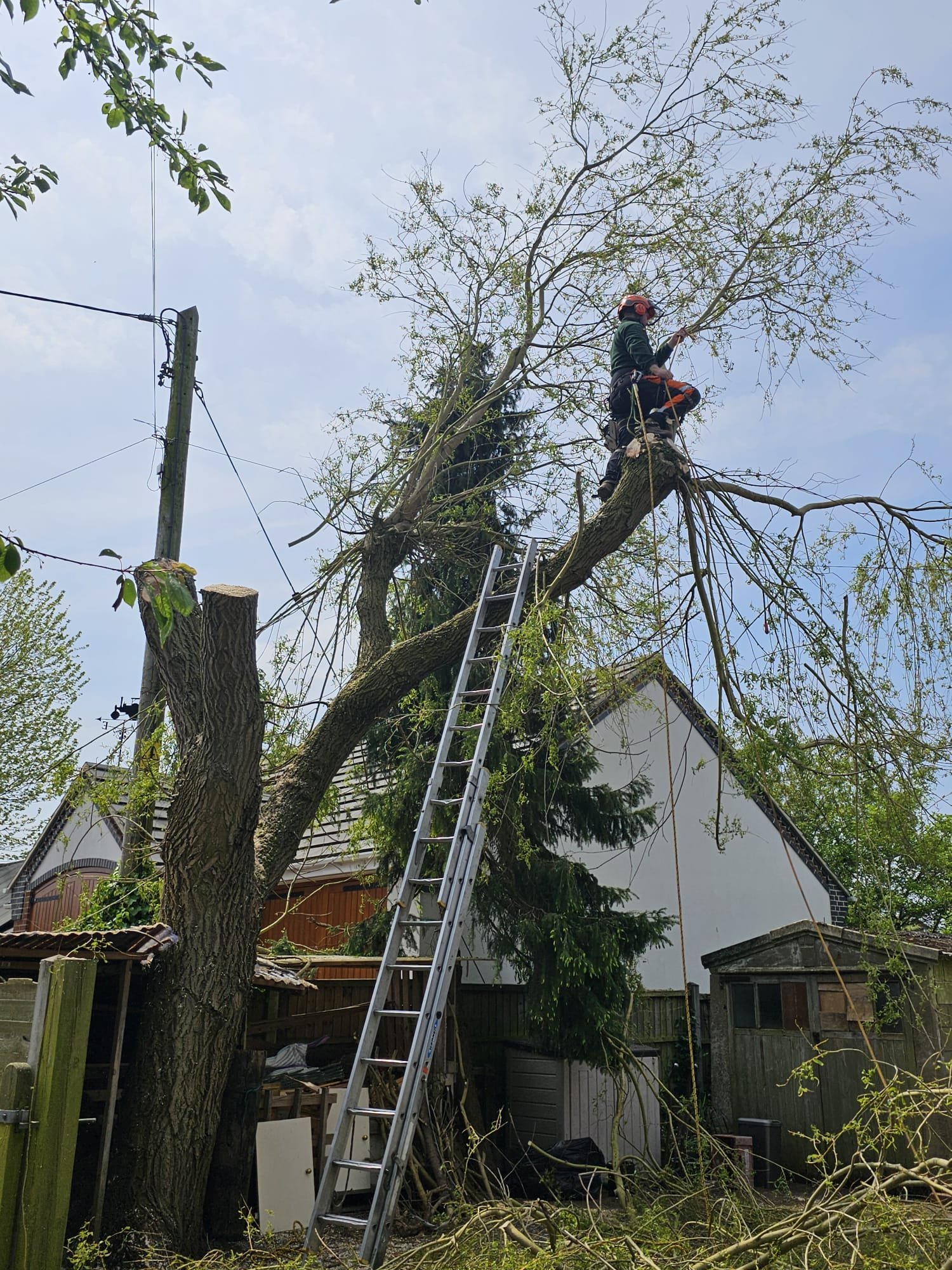
Deadwood removal is climbing work, because the branches that matter are out in the crown rather than within reach of a pole saw from the lawn. The climber moves through the tree on rope, cuts back to the branch collar so the tree’s own boundary is left intact, and the material comes down into a cleared area below.
It is a shorter job than a reduction, and it is usually worth combining with anything else the tree needs while somebody is up there — a lift over the drive, or a couple of specific branches off the roof line. Brash is chipped and cleared as standard.
Ready to book Deadwood Removal in Nottingham, or still have a question?
Get In Touch →